
Master Your Mindset: Daily Habits for Mental Resilience

Personal Development
Emotional Intelligence
Growth Mindset
Daily Habits
Mental Resilience
Mindset Mastery
Personal Development
Healthy Mindset
In a world where uncertainty, stress, and rapid change have become the norm, mental resilience stands as a vital skill. It’s the mental armor that empowers you to face hardships, recover from setbacks, and maintain your well-being. This guide will take you on a deep dive into mastering your mindset through proven, practical, and transformative daily habits. Each habit is designed to your mental strength, sharpen your focus, and your health Ready to transform your inner world? Let’s begin. 🌟
What is Mental Resilience?
Mental resilience is your brain’s ability to adapt, recover, and even grow stronger in response to adversity. It’s not about avoiding difficulties but about:
- Bouncing back quickly from failures or emotional wounds.
- Sustaining optimism and motivation in tough times.
- Adapting creatively to changing situations.
- Maintaining emotional balance under pressure.
Think of it as a muscle — the more you train it, the stronger it becomes.
🌍 Why Mastering Your Mindset is a Game-Changer
Your mindset is the lens through which you view life. It determines how you interpret events, how you respond emotionally, and what actions you take.
A resilient mindset helps you:
- Defuse stress and anxiety 🔥
- See challenges as stepping stones, not roadblocks 🛤️
- Maintain calmness and clarity under pressure 🧘♀️
- Keep moving forward even when the path gets rough 🚀
🔑 Daily Habits to Build Unshakeable Mental Resilience
1. Mindfulness & Meditation: Train Your Brain to Pause 🧘♂️
Mindfulness is the art of being fully present aware but not overwhelmed by your thoughts and feelings.
- How to practice: Begin with 5 minutes of focused breathing each morning. Observe your breath, notice thoughts without judgment, then gently bring your focus back.
- Deep benefit: Mindfulness rewires your brain’s stress response, calming the amygdala (your brain’s alarm system) and strengthening the prefrontal cortex (your decision-making center). This neurological shift makes you less reactive and more responsive to stress.
Daily tip: Use apps like Headspace or Calm to guide your meditation.
2. Adopt a Growth Mindset: Embrace Challenges as Fuel for Growth 🌱
People with a fixed mindset believe traits are static you’re either smart or you’re not. A growth mindset says, “I can develop skills with effort.”
- Daily habit: When you face a setback, ask yourself: “What can I learn here?” or “How can I improve?”
- Power insight: Neuroscience shows that challenges stimulate brain plasticity, helping form new neural pathways. This means your brain literally grows stronger when you push through difficulties.
Pro tip: Replace self-limiting phrases like “I’m not good at this” with “I’m learning every day.”
3. Gratitude Practice: Rewire Your Brain for Positivity 🙏
Gratitude is more than a mood booster it’s a mental resilience powerhouse.
- How to do it: Write down three things you’re grateful for every morning or evening. Include simple joys like a smile, nature’s beauty, or a kind word.
- Science says: Gratitude activates the hypothalamus, which regulates stress and energy levels. It also boosts dopamine, the brain’s “feel-good” chemical, strengthening your emotional well-being.
Extra tip: Share your gratitude with others it deepens social bonds.
4. Move Your Body: Exercise for Mental Strength 🏃♀️💥
Physical activity is like a supercharger for your brain.
- Daily routine: At least 30 minutes of moderate exercise walking, yoga, cycling, or dancing.
- Why it works: Exercise releases endorphins, reduces cortisol (the stress hormone), and promotes neurogenesis the creation of new brain cells, especially in areas linked to memory and mood regulation.
Motivation hack: Find an exercise buddy or join group classes to stay accountable.
5. Set Clear Goals & Prioritize: Create a Roadmap to Success 🎯📅
Clarity breeds confidence.
- Action step: Break big ambitions into small, manageable tasks. Prioritize your top 3 tasks each day.
- Mental effect: Achieving small wins activates your brain’s reward system, releasing dopamine. This builds momentum and resilience.
Tool suggestion: Use planners like Notion, Trello, or simple bullet journals.
6. Cultivate Meaningful Relationships: Your Emotional Lifeline 🤗
Strong social connections provide emotional scaffolding.
- Daily effort: Reach out to friends, family, or mentors. Share openly and listen actively.
- Why it matters: Social support lowers your body’s stress responses and increases oxytocin, which promotes feelings of trust and safety.
Bonus: Join groups or communities with shared interests to broaden your support network.
7. Practice Self-Compassion: Be Your Own Best Friend 💖
When you stumble, how you talk to yourself matters deeply.
- Daily reflection: Notice harsh self-criticism and gently replace it with kind, supportive words.
- Research insight: Self-compassion reduces anxiety and depression by lowering activity in the brain’s threat center and increasing activation in regions linked to emotional regulation.
Try this: Repeat affirmations like “I’m doing my best and that’s enough.”
8. Limit Digital Overload: Protect Your Mental Space 🌿
Incessant exposure to social media and negative news fuels anxiety and comparison.
- Set boundaries: Designate tech-free zones or times (e.g., no phone after 8 pm).
- Choose wisely: Consume uplifting or educational content that inspires and informs.
Effect: Reduces cognitive fatigue and cultivates mental clarity.
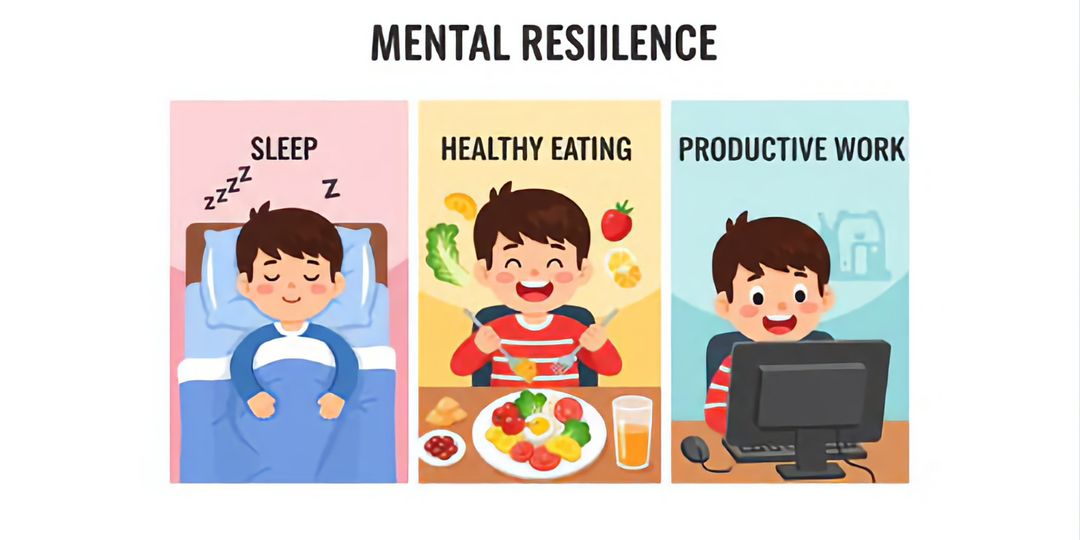
9. Prioritize Restorative Sleep: Recharge Your Brain Every Night 🛌
Sleep is the foundation of cognitive resilience.
- Ideal routine: 7-9 hours per night with consistent bedtimes.
- Why it’s essential: During deep sleep, your brain clears toxins, consolidates memories, and resets emotional circuits, improving mood and decision-making.
Sleep hygiene tips: Avoid screens 1 hour before bed; create a calming bedtime ritual like reading or gentle stretches.
10. Daily Reflection & Journaling: Organize Your Inner World 📓
Journaling is a powerful way to process emotions and track growth.
- How: Spend 5–10 minutes each evening writing about your thoughts, feelings, and lessons from the day.
- Scientific benefit: Journaling boosts emotional intelligence and reduces mental clutter, helping you approach challenges with clarity.
Prompt ideas: “What challenged me today? How did I respond? What can I improve?”
Quick Start Routine for Mental Resilience
| Time | Habit | Why It Works |
|---|---|---|
| Morning | Gratitude + Set 1 Small Goal 🙏🎯 | Starts day positively, builds focus |
| Midday | Mindful Break / Walk 🧘♀️🚶♂️ | Calms stress, refreshes energy |
| Evening | Journaling + Self-Compassion 🖊️💖 | Processes emotions, nurtures kindness to self |
| Throughout | Move Your Body + Connect with People 🏃♂️🤝 | Boosts mood, strengthens social support |
| Daily | Limit Digital Overload + Sleep Hygiene 📵🛌 | Protects mental space and restores brain |
Emotional Triggers: Learning to Respond, Not React
Everyone has emotional triggers — situations, words, or memories that spark stress or anxiety. Resilient people aren’t trigger-free; they’re trigger-aware.
A practical approach:
- Notice what sets you off
- Observe your physical reaction (tight chest, racing thoughts)
- Pause before responding
This pause creates space between emotion and action — and that space is where resilience lives.
Resilience Takes Time - and That’s Okay
Many people give up because they expect immediate change.
But mental resilience develops gradually:
- Some days you’ll feel strong
- Other days you’ll feel exhausted
- Progress won’t be linear
This is normal.
The goal isn’t constant positivity - it’s emotional flexibility. The ability to feel deeply, recover gently, and keep going.
The Role of Stillness in a Busy World
In a world obsessed with productivity, stillness is often undervalued.
Yet stillness:
- Calms the nervous system
- Restores mental clarity
- Helps you reconnect with yourself
Even a few minutes of silence each day can reset your mental state and prevent burnout.
Resilience Doesn’t Mean You Never Struggle
A resilient mindset doesn’t eliminate sadness, fear, or frustration.
It means:
- You don’t shame yourself for struggling
- You allow emotions without being consumed by them
- You trust your ability to recover
True strength is gentle, not rigid.
Creating a Personal Resilience Philosophy
Over time, it helps to define your own guiding principles. For example:
- “I can handle discomfort.”
- “This moment will pass.”
- “I grow through experience.”
These internal beliefs act as anchors when life feels uncertain.
Final Words: Your Mindset is Your Most Powerful Tool
Resilience Is a Relationship With Yourself
At its core, mental resilience is about how you relate to yourself during hardship.
Do you criticize or support?
Rush or breathe?
Resist or accept?
When you learn to stand beside yourself — not against yourself — resilience becomes a natural response, not a forced effort.
You don’t need to be perfect.
You just need to keep showing up.
Subscribe to our Newsletter
Provide your email to get email notification when we launch new products or publish new articles