
SQL vs NoSQL : Which Database is Right for You?

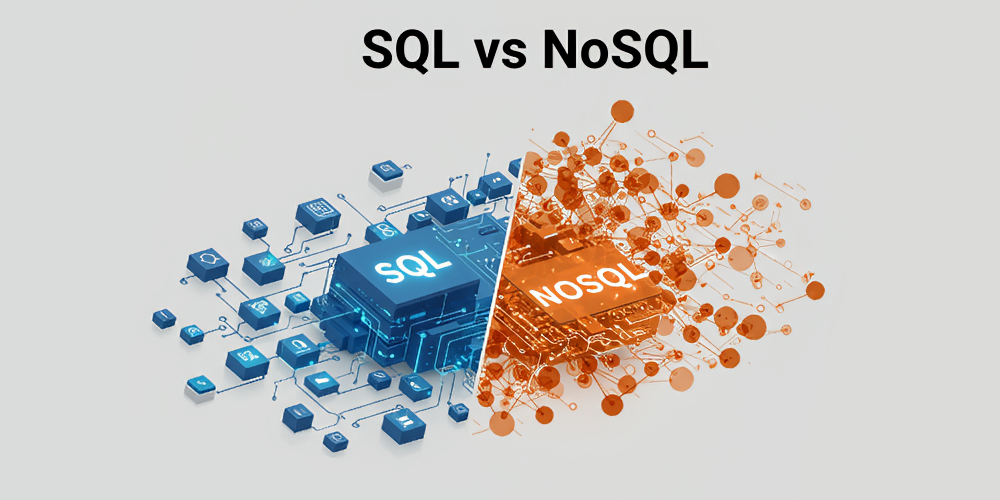
SQLvsNoSQL
PostgreSQL
MongoDB
NoSQL
SQL
DatabaseComparison
Deep dive into SQL vs NoSQL with updated trends, practical examples, and guidance on picking the right one in today’s data-driven world.
What is SQL?
SQL (Structured Query Language) is used to manage relational databases systems that store data in organized tables with predefined schemas. SQL databases like PostgreSQL, MySQL, and SQL Server use structured rows and columns, and they support powerful queries through commands like SELECT, JOIN, and GROUP BY.
SQL databases are still widely used for applications that require:
- Structured data with relationships (e.g., users, products, orders)
- High data integrity (ACID compliance)
- Complex queries and reporting
- Stable schemas
What is NoSQL?
NoSQL (Not Only SQL) refers to a group of non-relational databases designed for scalability, flexibility, and performance. These systems don’t rely on fixed table schemas instead, they store data in formats like JSON documents, key-value pairs, wide-columns, or graphs.
Popular NoSQL databases include MongoDB 8.0, Cassandra 5.1, and DynamoDB. These are perfect for:
- Semi-structured or unstructured data
- Applications that need to scale horizontally across many servers
- Real-time, cloud-native, or IoT-based systems
- Fast development cycles where schemas change frequently
What’s the Core Difference?
At the heart of it:
| SQL (Relational) | NoSQL (Non-Relational) |
|---|---|
| Structured Schema | Dynamic, Flexible Schema |
| Uses Tables | Uses Document, Key-Value, Column, or Graph |
| Strong ACID compliance | BASE model with eventual consistency |
| Ideal for structured data | Great for semi-structured or unstructured data |
| Examples: MySQL, PostgreSQL, SQL Server | Examples: MongoDB, Cassandra, DynamoDB |
📈 SQL in 2025: Still Relevant, Still Evolving
SQL databases have not become outdated. In fact, they’ve gotten better. Here’s how:
Top SQL Trends in 2025
- PostgreSQL 17 (released March 2025) includes built-in AI functions and better JSONB performance.
- Cloud-Native SQL: Services like Amazon RDS, Google Cloud SQL, and Azure Database for PostgreSQL offer auto-scaling, AI-tuned queries, and automatic backups.
- Hybrid Data Support: SQL databases can now efficiently handle JSON, XML, and full-text search — breaking the myth that only NoSQL is flexible.
When to Choose SQL
- You need strong data integrity (e.g., financial, eCommerce apps).
- Your data is highly structured and relational.
- You expect complex queries and multi-table joins.
- You require ACID compliance — Atomicity, Consistency, Isolation, Durability.
Best SQL Options in 2025:
✔ PostgreSQL 17 (most feature-rich open-source)
✔ MySQL 9.2 (stable, high performance)
✔ Microsoft SQL Server 2025 (enterprise-grade)
NoSQL in 2025: The Powerhouse of Scalability
NoSQL continues to dominate real-time, big data, and distributed applications.
🔹 Top NoSQL Trends in 2025
- MongoDB 8.0 (released April 2025) now supports native vector search for AI/ML apps.
- Serverless NoSQL: Firebase Firestore and AWS DynamoDB now auto-scale based on function execution, not just storage.
- Edge Database Support: Solutions like Couchbase Lite and PlanetScale now run at the edge for IoT and mobile-first apps.
When to Choose NoSQL
- You need to store flexible or rapidly changing data (like user preferences, chat logs).
- You're building a high-performance, globally distributed system.
- You’re handling massive volumes of semi-structured/unstructured data (like media files, logs, telemetry).
- You want horizontal scalability and fast write speed.
Best NoSQL Options in 2025:
✔ MongoDB 8.0 (general-purpose, document-oriented)
✔ Cassandra 5.1 (time-series, high write load)
✔ DynamoDB (serverless, auto-scaling)
SQL vs NoSQL: Feature-by-Feature Comparison
| Feature | SQL | NoSQL |
|---|---|---|
| Schema | Fixed (Structured) | Flexible or Schema-less |
| Transactions | Full ACID | Limited or Eventual Consistency |
| Scalability | Vertical (some horizontal options) | Horizontal (scale-out) |
| Query Language | SQL | Varies (MongoQL, CQL, etc.) |
| Use Case | Relational data, joins | Big data, real-time apps |
| AI Support | PostgreSQL 17 supports embedded AI | MongoDB 8.0 supports vector search |
| Cloud Support | High | Very High (Serverless-ready) |
Use Case Examples
🛒 E-Commerce Website
- SQL: Inventory, orders, payments (PostgreSQL)
- NoSQL: Product catalog, user activity, recommendations (MongoDB)
📱 Mobile Chat App
- SQL: User authentication (SQLite / Supabase)
- NoSQL: Messages, presence, push notifications (Firebase Firestore)
⚙️ IoT Analytics Platform
- SQL: Device registry, user settings (MySQL)
- NoSQL: Sensor data streams, logs (Cassandra / InfluxDB)
🧬 AI/ML Application
- SQL: Metadata, experiment results (PostgreSQL)
- NoSQL: Vector embeddings, prompt logs (MongoDB / Pinecone)
💬 Hybrid Approach: The Best of Both Worlds
Many modern systems use both SQL and NoSQL. This is called polyglot persistence. Example:
- SQL for transactions + NoSQL for scalability
- PostgreSQL for billing + DynamoDB for analytics
Popular frameworks and cloud platforms now make it easier than ever to integrate both types seamlessly in one project.
⚖️ Final Verdict: How to Choose
| Question | Go with SQL if | Go with NoSQL if |
|---|---|---|
| Do you need transactions? | Yes | Maybe not |
| Do you deal with structured data? | Yes | Not necessarily |
| Do you expect rapid schema changes? | No | Yes |
| Is horizontal scaling important? | Not critical | Very important |
| Do you need flexibility and speed? | Less | More |
🛠️ Pro Developer Tip
“Don’t just choose based on trends. Choose based on your application’s data model, scale, consistency needs, and developer skills.”
Migration Reality: Switching Is Harder Than Choosing
One of the biggest mistakes developers make is assuming they can easily switch databases later. In practice:
- Migrating SQL → NoSQL often requires redesigning the entire data model
- Migrating NoSQL → SQL usually means enforcing structure on years of flexible data
This is why early architectural thinking matters.
Pro tip:
If you’re unsure, start with SQL + JSON support (like PostgreSQL). It gives you structure and flexibility without locking you in too early.
Data Modeling Mindset: Tables vs Documents
Many beginners think the difference is technical — but it’s actually conceptual.
- SQL forces you to think relationally
- Normalize data
- Avoid duplication
- Think in joins
- NoSQL forces you to think in access patterns
- How will the data be read?
- What needs to be fast?
- What can be duplicated safely?
There is no “better” mindset — only a more suitable one for your use case.
Performance Myths That Need to Die
Let’s clear up a few common misconceptions:
❌ “NoSQL is always faster”
→ Not true. Poorly designed NoSQL schemas can be slower than optimized SQL queries.
❌ “SQL can’t scale”
→ Modern SQL databases scale vertically and horizontally using read replicas, sharding, and cloud-native tooling.
❌ “NoSQL means no consistency”
→ Many NoSQL databases now support tunable consistency and even ACID transactions.
Performance depends more on design choices than database type.
Testing & Debugging: A Hidden Difference
Debugging SQL systems often feels easier because:
- Queries are explicit
- Constraints catch errors early
- Transactions provide predictable behavior
In contrast, NoSQL bugs often appear later because:
- Schema issues aren’t enforced
- Invalid data can slip in silently
- Edge cases show up at scale
This doesn’t make NoSQL worse — it just demands better discipline from developers.
🔐 Security & Compliance Considerations
If your application deals with:
- Payments
- Personal user data
- Healthcare or financial records
SQL databases are often preferred due to:
- Strong transactional guarantees
- Mature access control systems
- Easier auditing and compliance
That’s why banks, governments, and enterprise systems still rely heavily on SQL.
The Smart Approach in 2025: Start Simple, Scale Smart
A realistic modern strategy looks like this:
- Start with SQL for core business logic
- Add NoSQL only when needed (analytics, logs, feeds, AI data)
- Keep responsibilities clear between databases
- Monitor real usage — not assumptions
This avoids premature complexity while keeping your system future-proof.
📌 Final Takeaway for Developers
Instead of asking
“Which database is better?”
Ask
“What problem am I solving right now?”
Databases are tools — not trends.
A well-designed SQL system will always outperform a poorly designed NoSQL one, and vice versa.
📢 Stay Updated
If you’re building modern apps in 2025, it’s important to keep up with database innovations. Follow the official blogs of:
Subscribe to our Newsletter
Provide your email to get email notification when we launch new products or publish new articles