
Top Programming Languages in 2025: Which Ones Are Worth Learning and Why

coding
easiest coding
web dev
full stack coding
In the world of technology, programming languages are the backbone of software development. Whether you’re building a mobile app, a website, or a data science model, the choice of language can significantly affect performance, scalability, and career opportunities. But with so many options out there, which languages are the best to learn in 2025 and why?
🌐 1. JavaScript – The Universal Frontend (And Backend!) Language
🧩Core Concepts:
- Event-driven, single-threaded, non-blocking I/O
- Executes in browser environments (via V8 engine) and server (Node.js)
- Uses prototypal inheritance, not classical OOP
🔍 Why JavaScript Still Reigns:
- Runs everywhere: desktops, browsers, servers, IoT devices
- Asynchronous design (using Promises and async/await)
- Ecosystem: npm has 2+ million packages—the world's largest open source registry
🔧 Key Libraries & Frameworks:
- Frontend: React, Vue, Svelte, Angular
- Backend: Express.js, NestJS
- Tools: Webpack, Babel, ESLint, Vite
Used In:
- Web apps (e.g., Twitter, Spotify)
- SPAs, PWAs, serverless functions (Vercel, Netlify)
💼 Career Impact:
Frontend Dev, Full-Stack Engineer, Next.js/React Developer
Demand Level: 🔥 Extremely high
🐍 2. Python – The Language of Logic, Data, and AI
Core Concepts:
- Interpreted, dynamically typed
- Supports multiple paradigms: OOP, functional, imperative
- Garbage collected, uses CPython (main interpreter)
🤖 Why Python Is Irreplaceable:
- Syntax is readable like English
- Used heavily in scientific computing and AI/ML
- Seamless integration with C/C++ for performance-critical tasks
🔧 Libraries & Frameworks:
- AI/ML: TensorFlow, PyTorch, Scikit-learn, HuggingFace
- Data: Pandas, NumPy, Matplotlib, Seaborn
- Web: Django, Flask, FastAPI
Used In:
- Machine Learning Models
- Big Data Pipelines
- Automation Scripts (RPA, DevOps)
💼 Career Impact:
Data Scientist, ML Engineer, AI Researcher, Python Backend Developer
Demand Level: 🔥🔥 Hyper-growth sector
☕ 3. Java – The Scalable, Enterprise Backbone
🧩 Core Concepts:
- Compiled to bytecode, runs on Java Virtual Machine (JVM)
- Strong OOP structure
- Statically typed, multi-threaded, secure
🏢 Why Enterprises Still Love Java:
- Backward compatibility: code from 10 years ago still works
- Runs on everything from ATMs to Android phones
- Mature ecosystem and powerful tools (Eclipse, IntelliJ, Spring)
🔧 Libraries & Frameworks:
- Web: Spring Boot, Jakarta EE
- Mobile: Android SDK
- Data: Apache Kafka, Hadoop, Elasticsearch APIs
🧠 Used In:
- Bank & financial systems
- High-load enterprise apps
- Android apps (Java & Kotlin hybrid)
💼 Career Impact:
Enterprise Architect, Android Developer, Backend Engineer
Demand Level: 📈 Steady and respected
🌀 4. Go (Golang) – Google’s Performance Weapon
🧩 Core Concepts:
- Compiled, statically typed, garbage collected
- Built-in concurrency using goroutines and channels
- Minimalist syntax (one way to do everything)
⚙️ Why Go Excels:
- Blazing fast build times
- Native concurrency → ideal for modern cloud apps
- Used to build infrastructure like Docker, Kubernetes, and Terraform
🔧 Libraries & Tools:
- The standard library is incredibly rich
- Gin (HTTP web framework), GORM (ORM)
- Strong native support for REST APIs and gRPC
Used In:
- Microservices architectures
- DevOps tools
- Scalable APIs, distributed systems
💼 Career Impact:
Backend Dev, DevOps Engineer, Cloud Native Architect
Demand Level: 🚀 Climbing rapidly in cloud tech
🦀 5. Rust – The Systems Language Reinvented
Core Concepts:
- Compiled, statically typed
- Memory-safe without garbage collection
- Enforces ownership model and lifetimes
🛡 Why Developers Love Rust:
- No null, no segfaults, thread safety by design
- Performance equals or exceeds C/C++
- Used in Linux kernel, Firefox, and blockchain tech
🔧 Ecosystem:
- Cargo (package manager + build tool)
- Actix & Rocket (web frameworks)
- Tokio (asynchronous runtime), WASM support
Used In:
- System-level programming
- Embedded development
- High-performance applications (e.g., games, compilers)
💼 Career Impact:
Systems Engineer, Blockchain Dev, Embedded Dev
Demand Level: 🌟 Niche but booming
📱 6. Kotlin – The JetBrains-Backed Android Star
Core Concepts:
- Interoperable with Java
- Statically typed with type inference
- Coroutines for structured concurrency
📲 Why Kotlin Is an Android Power Tool:
- Cleaner and more expressive than Java
- First-class support by Google for Android development
- Extends into server-side (Ktor), multiplatform (KMP)
🔧 Libraries & Tools:
- Ktor (backend framework), Jetpack Compose (UI toolkit)
- Anko, Exposed (ORM), Android SDK
Used In:
- Mobile apps (Android)
- Server-side Kotlin
- Kotlin Multiplatform for shared codebases
💼 Career Impact:
Android Developer, Mobile Dev Lead, Cross-platform App Developer
Demand Level: 🔥 Very high in the mobile market
🍏 7. Swift – Apple's Answer to Modern Development
Core Concepts:
- Compiled, statically typed
- Type-safe, null-safe
- Supports OOP and functional paradigms
🍎 Why Swift Stands Out:
- Native to iOS/macOS/watchOS/tvOS
- SwiftUI allows declarative UI development
- Easier and faster than Objective-C
🔧 Tools & Frameworks:
- Xcode, SwiftUI, Combine (reactive programming)
- Vapor (Swift on server)
- ARKit, CoreML for AR & ML apps
Used In:
- iPhone/iPad apps
- WatchOS apps
- Server-side Swift (early adoption)
💼 Career Impact:
iOS Developer, Swift UI Engineer
Demand Level: 📈 Stable, niche but well-paid
8. C# – Microsoft’s Productivity Powerhouse
Core Concepts:
- Compiled to Intermediate Language (IL), runs on .NET CLR
- Modern features: LINQ, async/await, pattern matching
- Object-oriented with functional capabilities
🖥 Why C# Still Dominates:
- Unity game engine
- ASP.NET Core for web apps
- Xamarin/.NET MAUI for cross-platform mobile apps
🔧 Libraries & Frameworks:
- Unity (Game Dev)
- .NET Core, Blazor, Entity Framework
- ML.NET for machine learning
Used In:
- Enterprise apps
- Games (console, PC, mobile)
- Backend systems
💼 Career Impact:
Game Dev (Unity), .NET Developer, Cloud Dev
Demand Level: 🚀 Especially in gaming + enterprise
🗃️ 9. SQL – The Query Language for All Data
Core Concepts:
- Declarative query language
- Operates over relational databases
- Supports joins, filters, and aggregations
🔍 Why SQL Still Matters:
- Every app needs data persistence
- Foundational in analytics and reporting
- Powers PostgreSQL, MySQL, SQL Server, and modern OLAP systems
🔧 Tools:
- pgAdmin, MySQL Workbench, DBeaver
- ORMs: Sequelize, Prisma, Hibernate
Used In:
- Data warehouses
- Backend CRUD APIs
- ETL pipelines
Final Thoughts: Choose Based on Your Goal
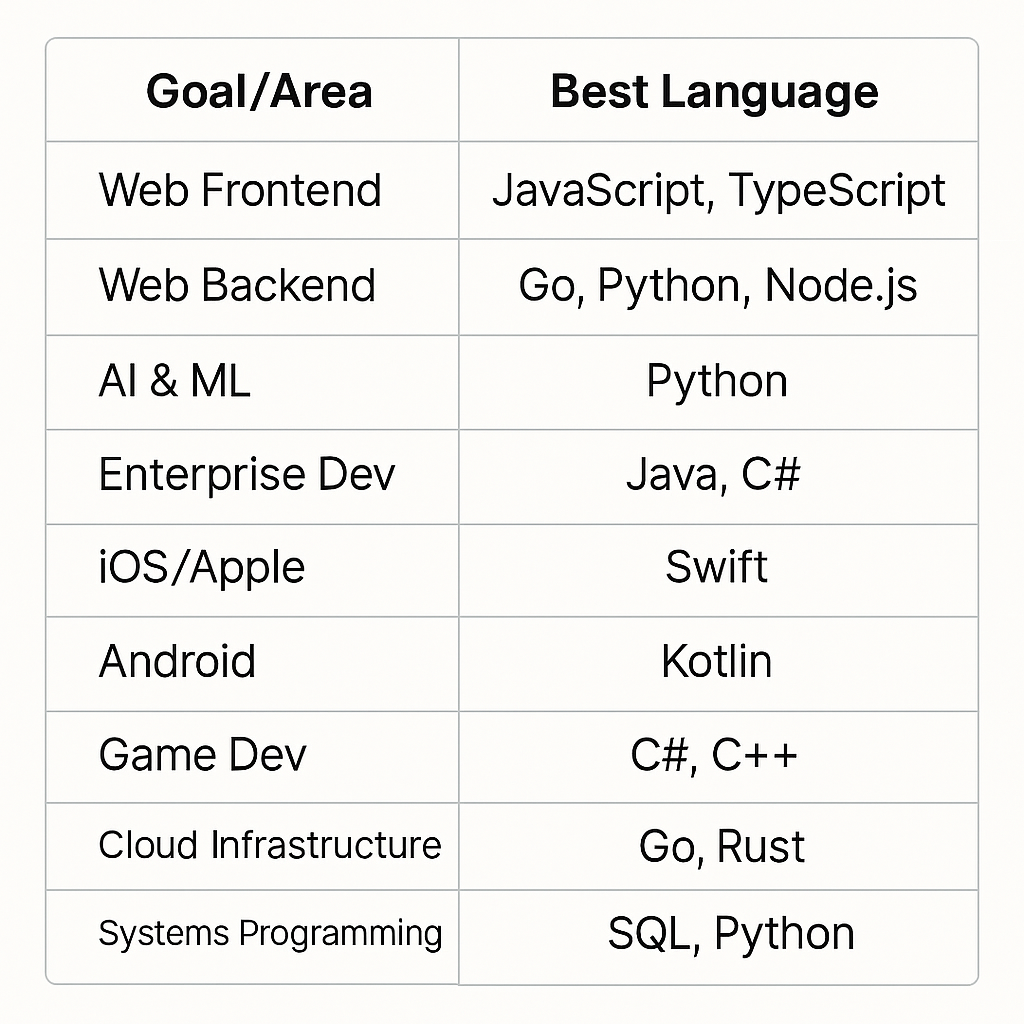
Final Thoughts: Choose Based on Your Goal
💼 Career Impact:
Data Analyst, Business Intelligence Engineer, Full-Stack Dev
Demand Level: Always relevant
Advanced Programming Trends in future: Staying Ahead of the Curve
While knowing languages is crucial, 2025 is all about applying them efficiently in modern development workflows. Here’s how developers are leveraging these languages to build cutting-edge applications.
1. Full-Stack Mastery: Combining Frontend & Backend
Modern development often requires expertise in multiple languages simultaneously:
- JavaScript + Node.js: Powering dynamic web apps and serverless functions
- Python + FastAPI/Django: AI-driven web apps, APIs, and data pipelines
- Java + Spring Boot: Enterprise-grade backend systems for scalable web platforms
Tip: Developers who understand the entire stack frontend, backend, databases, and deployment—stand out in the job market.
2. Cloud-Native & Serverless Development
Cloud computing has reshaped how we write and deploy applications:
- Go, Python, and JavaScript dominate serverless platforms like AWS Lambda, Google Cloud Functions, and Azure Functions
- Developers now write microservices that scale automatically without worrying about servers
- Kubernetes, Docker, and Terraform are often used alongside these languages for orchestration and infrastructure-as-code
Impact: Faster deployment, global scalability, and reduced infrastructure costs make cloud-native skills essential.
3. AI & Machine Learning Integration
Programming languages like Python and JavaScript are now essential for AI and machine learning applications:
- Python remains the go-to language for ML/AI thanks to TensorFlow, PyTorch, and Scikit-learn
- JavaScript enables AI-powered web apps with TensorFlow.js and Brain.js
- Rust and Go are being used in high-performance ML pipelines and real-time AI services
Career Tip: Combining traditional software development skills with AI/ML expertise dramatically increases employability.
4. Mobile & Cross-Platform App Development
Mobile apps continue to thrive, and developers need cross-platform knowledge:
- Kotlin: Android-native apps, server-side apps, and multiplatform projects
- Swift: iOS/macOS apps with SwiftUI for elegant and fast UIs
- C# (.NET MAUI & Unity): Games and apps across mobile, PC, and console platforms
Trend 2025: Cross-platform frameworks and shared codebases allow faster development cycles and maintainable apps.
5. Systems Programming & Performance-Critical Applications
Languages like Rust and Go are redefining performance-focused development:
- Rust eliminates memory errors and is used in blockchain, OS, and high-performance apps
- Go simplifies concurrency, making it ideal for cloud-native APIs and distributed systems
- C and C++ remain important for embedded systems, gaming engines, and legacy systems
Advice: Learning a systems-level language ensures you can handle projects requiring maximum performance and reliability.
6. Data & Analytics: The Backbone of Decision-Making
SQL and Python dominate data-intensive applications:
- SQL: Essential for querying, analytics, and maintaining structured databases
- Python + Pandas/Numpy: For data cleaning, visualization, and statistical modeling
- Modern tools: Apache Kafka, Spark, and BigQuery often integrate with these languages for real-time analytics
Takeaway: A solid understanding of databases and data processing is now a critical skill for every full-stack or backend developer.
7. Emerging Trends: Low-Code, No-Code & AI Assistance
- Low-code/no-code platforms are integrating Python, JavaScript, and TypeScript to allow rapid prototyping
- AI-powered IDEs assist in writing, debugging, and optimizing code across all major languages
- Automation, DevOps, and AI tools are increasingly language-agnostic but require programming fundamentals to customize and maintain
Impact: Developers who understand both traditional coding and modern automation tools gain a huge productivity edge.
Conclusion
"There is no best language—only the best fit for a problem."
Each programming language has its own purpose, strengths, and community. Choosing the right one depends on your goals—whether you’re interested in web development, AI, mobile apps, or systems programming. The real trick is to start learning, keep practicing, and adapt to the ever-changing tech landscape.
Subscribe to our Newsletter
Provide your email to get email notification when we launch new products or publish new articles